Landlords and property managers
Colorado Residential Lease Agreement
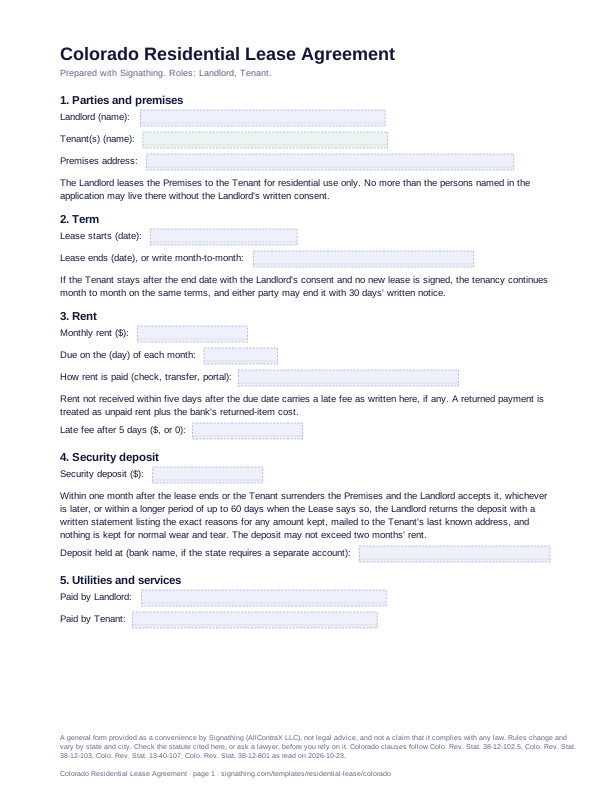
A plain-language lease for a house or apartment in Colorado. The deposit, notice and disclosure clauses follow Colorado statute, cited in the document. Download the blank PDF or e-sign it online; electronic signatures are recognized under the federal ESIGN Act and state UETA laws.
Use this template needs a free Signathing account, which is a code to your email or mobile number, no password. It copies the document and all 28 fields into your templates so you can send it in a minute.
Colorado rules in this lease
- Security deposit cap
- No more than two months' rent
- Deposit return
- Within one month after the lease ends or the Tenant surrenders the Premises and the Landlord accepts it, whichever is later, or within a longer period of up to 60 days when the Lease says so, the Landlord returns the deposit with a written statement listing the exact reasons for any amount kept, mailed to the Tenant's last known address, and nothing is kept for normal wear and tear.
- Ending a month-to-month tenancy
- Either party ends a month-to-month tenancy with written notice given at least 21 days before the end of the monthly period when the tenancy has run less than six months, at least 28 days once it has run six months, and at least 91 days once it has run a year.
- Landlord entry
- No notice period in the statute; the lease uses 24 hours
- Disclosures
- 6 items, listed below with the section that requires each one
- Local rules
- Denver requires a residential rental property license and a Tenant Rights and Resources notice with every lease and rent demand.
- Statutes
- Colo. Rev. Stat. 38-12-102.5, Colo. Rev. Stat. 38-12-103, Colo. Rev. Stat. 13-40-107, Colo. Rev. Stat. 38-12-801. Read the Colorado statute
- Rules read on
- 2026-10-23
A general form, not legal advice, and not a claim that it complies with any law. Rules change and vary by city. Check the statute cited here, or ask a lawyer, before you rely on it.
What is different in Colorado
Pick Colorado and three parts of this lease change: the security deposit clause, the notice clause for a month-to-month tenancy and the disclosures checklist, each rewritten from the Colorado statute. The rest of the document reads the same in every state.
Start with the deposit. Colorado caps it at two months' rent. The statute does not say where the money is kept, so the lease leaves that to the landlord, but its return rule, quoted in full below, says when and how the deposit comes back, and leaves ordinary wear out of the deductions.
Ending a month-to-month tenancy works the same from both sides in Colorado. Either party ends a month-to-month tenancy with written notice given at least 21 days before the end of the monthly period when the tenancy has run less than six months, at least 28 days once it has run six months, and at least 91 days once it has run a year.
On entry the Colorado statute is silent, so the lease fills the gap with at least 24 hours' notice at a reasonable time and no notice in an emergency, and the footer says the statute set no period.
The disclosures checklist carries five Colorado items on top of the federal lead paint notice, among them bed bug disclosure, each with the section that requires it and a line for the landlord's initials.
City rules are the other thing to watch. Denver requires a residential rental property license and a Tenant Rights and Resources notice with every lease and rent demand. The state clauses follow four sections of Colorado law, read on October 23, 2026 and listed in the Statutes row above; the same citations print in the footer of the PDF.
Read the Colorado clauses
The wording below is what prints in the PDF for Colorado, word for word, under the headings Security deposit, Entry, Ending the lease and default, and Disclosures.
Security deposit
Within one month after the lease ends or the Tenant surrenders the Premises and the Landlord accepts it, whichever is later, or within a longer period of up to 60 days when the Lease says so, the Landlord returns the deposit with a written statement listing the exact reasons for any amount kept, mailed to the Tenant's last known address, and nothing is kept for normal wear and tear. The deposit may not exceed two months' rent.
Entry
The Landlord may enter at reasonable times to inspect, repair or show the Premises after at least 24 hours' notice, and without notice in an emergency.
Ending the lease and default
Either party ends a month-to-month tenancy with written notice given at least 21 days before the end of the monthly period when the tenancy has run less than six months, at least 28 days once it has run six months, and at least 91 days once it has run a year. If rent is unpaid or a term is broken, the Landlord gives the written notice Colorado law requires before ending the tenancy, and the Tenant is responsible for rent through the end of the term unless the Premises is re-rented sooner.
Disclosures the Landlord initials
- Lead-based paint and hazards, for a building built before 1978, with the EPA pamphlet (42 U.S.C. 4852d)
- Name and address of the Landlord and of any authorized agent, in the written lease, with a signed copy delivered within seven days after the Tenant signs (Colo. Rev. Stat. 38-12-801)
- A statement that source of income discrimination is prohibited under Colo. Rev. Stat. 24-34-502(1), unless the Landlord is exempt as a small landlord (Colo. Rev. Stat. 38-12-801)
- Radon disclosure with the state radon warning (Colo. Rev. Stat. 38-12-803)
- Bed bug disclosure (Colo. Rev. Stat. 38-12-1005)
- Warranty of habitability statement in English and Spanish (Colo. Rev. Stat. 38-12-503)
Denver requires a residential rental property license and a Tenant Rights and Resources notice with every lease and rent demand.
Footer of the PDF: Colorado clauses follow Colo. Rev. Stat. 38-12-102.5, Colo. Rev. Stat. 38-12-103, Colo. Rev. Stat. 13-40-107, Colo. Rev. Stat. 38-12-801 as read on 2026-10-23.
Colorado lease questions
- How much can a landlord charge for a security deposit in Colorado?
- No more than two months' rent. The cap comes from Colo. Rev. Stat. 38-12-102.5, and the lease repeats it in the deposit clause.
- When does the security deposit come back in Colorado?
- Within one month after the lease ends or the Tenant surrenders the Premises and the Landlord accepts it, whichever is later, or within a longer period of up to 60 days when the Lease says so, the Landlord returns the deposit with a written statement listing the exact reasons for any amount kept, mailed to the Tenant's last known address, and nothing is kept for normal wear and tear.
- How much notice ends a month-to-month tenancy in Colorado?
- Either party ends a month-to-month tenancy with written notice given at least 21 days before the end of the monthly period when the tenancy has run less than six months, at least 28 days once it has run six months, and at least 91 days once it has run a year.
- How much notice does a Colorado landlord give before entering?
- Colorado statute sets no notice period before the landlord enters, so this lease uses at least 24 hours' notice at a reasonable time, and no notice in an emergency.
- What does a Colorado landlord have to disclose with the lease?
- Beyond the federal lead paint disclosure for a building built before 1978, the Colorado checklist has five items: name and address of the Landlord and of any authorized agent, in the written lease, with a signed copy delivered within seven days after the Tenant signs; a statement that source of income discrimination is prohibited under Colo. Rev. Stat. 24-34-502(1), unless the Landlord is exempt as a small landlord; and radon disclosure with the state radon warning. The other two are on the checklist in the document. Each one names its statute and the landlord initials it in the document.
- Do any Colorado cities or counties add rules of their own?
- Denver requires a residential rental property license and a Tenant Rights and Resources notice with every lease and rent demand.
- Which Colorado statutes does this lease cite?
- Colo. Rev. Stat. 38-12-102.5, Colo. Rev. Stat. 38-12-103, Colo. Rev. Stat. 13-40-107 and Colo. Rev. Stat. 38-12-801, read on October 23, 2026. They print in the document footer so a reader can check each clause against the statute in a minute.
- Should a lawyer look at this Colorado lease before I use it?
- It is a general form, not legal advice, and it does not claim to comply with any law. The clauses state what the Colorado statute requires and name the statute. A lawyer who works with Colorado landlords can tell you whether the form fits your property, your city and the terms you want to add, which is worth the hour before signing a lease for a large rent or a long term.
Other states
- Alabama
- Alaska
- Arizona
- Arkansas
- California
- Connecticut
- Delaware
- District of Columbia
- Florida
- Georgia
- Hawaii
- Idaho
- Illinois
- Indiana
- Iowa
- Kansas
- Kentucky
- Louisiana
- Maine
- Maryland
- Massachusetts
- Michigan
- Minnesota
- Mississippi
- Missouri
- Montana
- Nebraska
- Nevada
- New Hampshire
- New Jersey
- New Mexico
- New York
- North Carolina
- North Dakota
- Ohio
- Oklahoma
- Oregon
- Pennsylvania
- Rhode Island
- South Carolina
- South Dakota
- Tennessee
- Texas
- Utah
- Vermont
- Virginia
- Washington
- West Virginia
- Wisconsin
- Wyoming
Who this is for. A Colorado lease is one half of a landlord's paperwork; proving a notice was received is the other. Both are covered at free e-signatures for landlords.
Free, and not the kind of free with a catch
Unlimited documents, up to 25 signers each, certified PDFs on every one. No trial clock and no card to start.
Start signing free