Tanning salons, and gyms and spas with tanning beds
Tanning Customer Acknowledgment
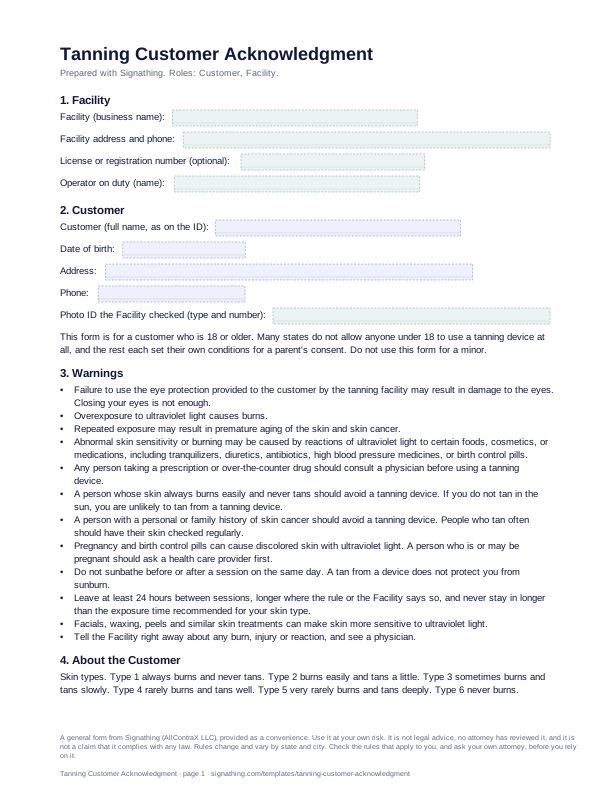
A warning statement and acknowledgment for an adult customer of a tanning facility, built from what state rules ask a customer to read and sign: the risks of ultraviolet light, medications and products that raise sensitivity, skin type, protective eyewear, and time between sessions. The page lists what every state and DC requires, with each rule cited.
Use this template needs a free Signathing account, which is a code to your email or mobile number, no password. It copies the document and all 28 fields into your templates so you can send it in a minute.
What is inside
- 1. Facility
- 2. Customer
- 3. Warnings
- 4. About the Customer
- 5. The Facility's part
- 6. The Customer's statements
- 7. What this form is, and local rules
- Signatures, with a signature, date and printed-name line for each role
Who signs
- 1. Customer
- 2. Facility
Good for
- A new customer's first visit, before the first session
- The yearly renewal many states ask for
- Keeping the signed statement on file for an inspection
What each state says about tanning paperwork
The form above is written once, for any state, and is for customers who are 18 or older. Below is what each state's own rule says about tanning under 18, what an adult customer must be given or must sign, and how long to keep records. Where a state has its own required form or sets the words of the statement, the note says so, and this form alone is not enough there.
Rules read on November 16, 2026. They change, and counties and cities often add their own. Follow the link and read the rule before you rely on a note here.
- Alabama
- Under 18: Not allowed at 14 or under unless a physician prescribes it. At 15, written consent from a parent or legal guardian signed at the facility, and that parent stays in the facility during the session. At 16 or 17, written consent signed at the facility. The consent must carry a warning the statute words.Adults: The state rule asks nothing in writing of an adult customer. No one may use a tanning device without protective eyewear. Jefferson County has its own act, with a county permit, a posted warning sign and injury reports to the county Board of Health.Keep records: Not stated.Ala. Code § 22-17B-2; Ala. Code § 22-17B-3; Ala. Code § 45-37-41.06 (Jefferson County)
- AlaskaNo state rule found
- Under 18: We found no state law on tanning by minors.Adults: We found no state rule on tanning facility paperwork.Keep records: Not stated.Alaska Statutes, Title 18 chapter list; Alaska Admin. Code, Title 18 chapter list
- ArizonaHas its own required form or wordingArizona version with this wording
- Under 18: Only with written permission from a parent or guardian. The sign the rule requires at the entrance says the authorization is signed in the presence of an operator of the facility.Adults: Before the first use in any 12-month period, the operator asks the user to read a copy of two warnings the rule words, the notice about users under 18 and the DANGER ultraviolet radiation warning, and the user signs a statement of having read or heard and understood them. If the warnings are read aloud, a witness signs too. The operator provides protective eyewear.Keep records: Each user's total number of uses and exposure times, for 3 years after the last date in the record.A.A.C. R9-7-1405
- Arkansas
- Under 18: No age is ruled out. Before the first exposure of a person under 18, the owner or operator watches a parent or legal guardian sign and date a warning statement whose words the statute sets.Adults: The state rule asks nothing in writing of an adult customer.Keep records: Not stated.Ark. Acts 2009, No. 707 (Ark. Code § 20-27-2202); Ark. Code § 20-27-2201
- California
- Under 18: Not allowed. Proof of age is a driver's license or other government ID with a photo and birth date.Adults: The facility gives each customer a written warning before use, and the customer signs a statement of having read and understood it and agreeing to use the eyewear the facility provides. It is renewed each calendar year. The warning covers eye damage, burns, skin aging and cancer, foods, cosmetics and medications that raise sensitivity, and who should avoid tanning. No wording is set for it.Keep records: The signed statement, until the end of the calendar year, when each current customer renews it.Cal. Bus. & Prof. Code §§ 22700 to 22708
- Colorado
- Under 18: The statute and rule we read set no age limit and ask for no parental consent.Adults: No signature is required. Before the first exposure the customer is given a copy of the warning statements: a list of drugs and agents that raise sensitivity to light, the health effects of ultraviolet exposure, how skin types respond, the need for protective eyewear, and when tanning is inadvisable. No wording is set for the handout. Eyewear must be worn while the lamps are on.Keep records: Not stated for customers. The records the rule lists are about equipment.6 CCR 1010-20; C.R.S. § 25-5-1007
- Connecticut
- Under 18: Not allowed under 17. The statute sets no condition at 17.Adults: The state rule asks nothing in writing of an adult customer. The one statute we read has no warning statement, eyewear or record rule. Municipal and district health departments may enforce it.Keep records: Not stated.Conn. Gen. Stat. § 19a-232
- DelawareHas its own required form or wordingDelaware version with this wording
- Under 18: Not allowed. The owner must make sure each customer is of legal age.Adults: No signature is required. Before each use the customer is given a written warning statement that carries five statements the statute words: eye injury without eye protection, burns, skin cancer and aging, foods, cosmetics and medications that raise sensitivity, and seeing a physician if taking any drug. Since September 2025 the state's regulation ends the fourth statement with "the use of oral contraception" where the statute says "birth control pills"; both are in force.Keep records: Not stated.16 Del. C. ch. 30D; 16 DE Admin. Code 4454
- District of ColumbiaHas its own required form or wordingDistrict of Columbia version with this wording
- Under 18: Not allowed. Proof of age is a driver's license or other government or school ID with a photo and birth date.Adults: Every customer signs and dates an acknowledgment of having received, read and understood the Warning Statement and agreeing to use protective eyewear. The Warning Statement is a text the rule words, ending with the address and phone of DC Health's Radiation Protection Division. A copy is given at the first visit and at least once a year. The rule does not say how often the acknowledgment is signed again.Keep records: 3 years for customers 18 and older, including tanning profiles, exposure schedule records and an incident log.25-F DCMR § 300; 25-F DCMR § 201; 25-F DCMR § 305
- Florida
- Under 18: Under 14, a parent or legal guardian must come along. From 14 to 17, the facility must have on file a statement signed by a parent or legal guardian who has read the warnings, consents, and agrees the minor will use the eyewear provided.Adults: Each time a person uses the facility or signs or renews a contract, the person signs a statement of having read and understood the warnings and agreeing to use protective eyewear. The written warning covers eye damage, burns, skin aging and cancer, foods, cosmetics and medications, and whether the facility carries liability insurance. No wording is set. No one may tan more than once every 24 hours.Keep records: 4 years: each customer's signature, age, visit dates, number of visits, exposure times and the employee who assisted.Fla. Admin. Code ch. 64E-17
- Georgia
- Under 18: Not allowed under 14. From 14 to 17, a parent or legal guardian signs a written consent form at the facility before the minor uses the equipment.Adults: The statute we read asks nothing in writing of an adult customer. The Attorney General's consumer page says every customer signs a written warning statement before first use and before contract renewals; we could not confirm that in the statute. The facility provides protective goggles and makes sure they are worn.Keep records: Written injury reports for at least 3 years. Not stated for consent forms.O.C.G.A. § 31-38-8; O.C.G.A. Title 31, ch. 38 (Georgia DPH copy); Georgia Attorney General, Tanning Equipment
- Hawaii
- Under 18: Not allowed, with no parental consent exception.Adults: The state rule asks nothing in writing of an adult customer. The facility posts a notice developed by the Director of Health.Keep records: Not stated.HRS § 321-12.2
- Idaho
- Under 18: Not allowed under 14. From 14 to 17, only with the prior written informed consent of a parent or legal guardian, signed in the presence of the person running the tanning device or that person's staff.Adults: The state rule asks nothing in writing of an adult customer. The only state provision found is the criminal statute on minors.Keep records: Not stated.Idaho Code § 18-1523
- IllinoisHas its own required form or wordingIllinois version with this wording
- Under 18: Not allowed, with or without a parent's permission. Age is checked with a government photo ID showing the birth date.Adults: At the first visit and at least once a year the consumer is given a written warning in the rule's own words and signs that it was read and understood. The consumer also fills out a form listing medications, cosmetics and toiletries in use and certifies not having tanned in the past 24 hours. A copy of the statute's warning label text is given before each use. Eyewear is mandatory.Keep records: At least 5 years after the last visit: the signed acknowledgment, the medication form (kept confidential), and each visit's date, duration and equipment.77 Ill. Adm. Code 795.190; 210 ILCS 145/25
- Indiana
- Under 18: Not allowed under 16. At 16 or 17, a parent or guardian must also sign the customer's written statement in the presence of the facility operator.Adults: Before using a device, and by rule each time the customer uses the facility or signs or renews a contract, the customer signs a statement of having read the warnings, agreeing to use the eyewear provided, and not having tanned in the past 24 hours. The statute lists six warnings and says the statement is one approved by the board; we could not confirm that the board issues a form.Keep records: The signed warning record for at least 24 months. Visit and time records on site for 1 year and for the board up to 5 years. A form with each customer's address, phone and age is a permanent record.IC 25-8-15.4-11; 820 IAC 5-1-33; IC 25-8-15.4-16
- IowaHas its own required form or wording
- Under 18: The statute and rule we read set no minimum age and ask for no parental consent.Adults: Before the first exposure and once a year after, the consumer reads three appendices printed in the state rule (agents that raise sensitivity to light, skin types, and the health effects of ultraviolet exposure) and signs a statement that they were read and understood. The operator checks that the consumer has protective eyewear.Keep records: 2 years, at the facility: the signed statement, visits, exposure times and dates, and any injury or illness.481 IAC ch. 496; Iowa Code ch. 136D
- Kansas
- Under 18: Not allowed. Age is checked from a current state or federal photo ID showing the birth date.Adults: The facility gives each customer a written statement of five warnings: eye damage without the eyewear provided, burns, skin aging and cancer, foods, cosmetics and medications that raise sensitivity, and seeing a physician if taking any drug. No signature is required and no wording is set. The operator provides protective eyewear before each use.Keep records: Not stated.K.S.A. 65-1921; K.S.A. 65-1931; K.A.R. 69-12-8
- Kentucky
- Under 18: Under 14, a parent or legal guardian must come along. From 14 to 17, the minor gives the facility a statement signed by a parent or legal guardian who has read the warnings, consents, and agrees the minor will use protective eyewear. It is valid for one calendar year.Adults: The facility gives each customer a written statement of five warnings: eye damage without the eyewear provided, burns, skin aging and cancer, foods, cosmetics and medications that raise sensitivity, and seeing a physician if taking any drug. No adult signature is required. The facility must make sure patrons use protective eyewear.Keep records: 2 years for parental consent forms and for records of use by minors 14 to 17. Nothing is stated for adults.KRS 217.924; KRS 217.922; 902 KAR 45:075
- Louisiana
- Under 18: Not allowed. A sign saying so is posted at the entrance.Adults: Before the first exposure the consumer is given a written warning statement, signs it and gets a copy. It lists six warnings: eye damage without the eyewear provided, burns, skin aging and cancer, foods, cosmetics and medications, seeing a physician if taking any drug, and not sunbathing before or after. No wording is set. The facility provides protective eyewear.Keep records: Signed warning statements permanently. Visit records (number, dates, durations) for 6 years.La. R.S. 40:2714; La. R.S. 40:2707; LAC 49:I.1337
- MaineHas its own required form or wording
- Under 18: Not allowed. Proof of age may be a driver's license or other government ID with a photo and birth date.Adults: Before the first use in each calendar year the customer signs a statement that, by statute, is developed by the department; we could not confirm that the department issues one. It carries the posted notice's information, an acknowledgment, an agreement to use protective eyewear, and language that the customer was trained to use the device. No one may tan more than once every 24 hours.Keep records: 3 years after the last visit: signed statements, visit dates and durations, and injury reports. The customer initials each visit entry.22 M.R.S. § 689-A; 10-144 CMR ch. 223
- MarylandSet by counties and cities
- Under 18: Not allowed, with no parental consent exception. The facility confirms age with a state or federal government ID.Adults: The state rule asks nothing in writing of an adult customer; it covers minors and a posted notice. Counties and cities may add their own rules. Howard County is one example: it requires every customer to receive and sign a warning statement before each tanning session.Keep records: Not stated by the state.Md. Code, Health-Gen. § 20-106; COMAR 10.52.06.01; Howard County Health Department, Tanning Facility Program
- MassachusettsHas its own required form or wording
- Under 18: Not allowed, with no parental consent exception.Adults: The warning statement is on a form provided by the state Department of Public Health and carries a six-point DANGER ULTRAVIOLET RADIATION text the statute words. The customer signs it before tanning unless it was signed in the past six months; the statute itself says each use or contract. The operator signs too, and a witness where possible. The operator provides eyewear and sets session length by skin type.Keep records: At least 1 year, at the facility: each visit's date, skin type determination, tanning times and device, plus the signed warning statement.105 CMR 123.003; M.G.L. c. 111, § 209; Mass. DPH tanning warning statement form
- Michigan
- Under 18: No age is ruled out. Under 18, a parent or legal guardian also signs the customer's statement, in person at the facility and in the presence of the owner or operator.Adults: The facility gives a written statement, and the customer signs at least once a year that it was read and understood and agrees to use protective eyewear. It covers eye damage, burns, skin aging and cancer, foods, cosmetics and medications, seeing a physician, reporting injuries to the owner, and sensitivity after microdermabrasion. No wording is set for the statement.Keep records: The signed statement, for at least 1 year.MCL 333.13405; MCL 333.13403
- Minnesota
- Under 18: Not allowed, with no parental consent exception.Adults: The state rule asks nothing in writing of an adult customer. The facility provides protective goggles and requires customers to wear them, and the operator instructs each user on the equipment and the maximum exposure time.Keep records: 3 years after exposure: each consumer's number of visits and the dates and durations of exposures.Minn. Stat. ch. 325H
- MississippiHas its own required form or wordingMississippi version with this wording
- Under 18: Under 14, written consent signed in front of the operator, and the parent or guardian stays for the whole session. From 14 to 17, written consent signed in front of the operator, good for one year, stating the relationship, the child's age and the most sessions allowed that year.Adults: Before the first exposure the consumer is given a copy of the DANGER ULTRAVIOLET RADIATION warning the rule words, and signs a statement that it was read and understood. The Department of Health publishes its own acknowledgment form (Form 151); the rule does not say that form must be used. A list of agents that raise sensitivity to light is explained at the first visit. Eyewear must be worn.Keep records: Each consumer's number of visits and total exposure time; no period is stated for adults. 2 years for minors' consent forms and session records.15 Miss. Admin. Code Pt. 14, Subpt. 70, ch. 6; MSDH Form 151, Consumer's Acknowledgement Statement; Miss. Code § 41-115-1
- Missouri
- Under 18: No age is ruled out. Before anyone under 17 uses a tanning device, a parent or guardian comes to the facility in person and signs the state's own consent form (MO 580-3077), and signs again each year.Adults: The state rule asks nothing in writing of an adult customer. It refers to the warnings given by the facility and does not say what they are.Keep records: Not stated.RSMo 577.665; 19 CSR 20-12.010
- MontanaNo state rule found
- Under 18: We found no state law on tanning by minors.Adults: We found no state rule on tanning facility paperwork.Keep records: Not stated.MCA Title 50 chapter index; MCA § 45-5-623
- Nebraska
- Under 18: Under 16, only when a parent or legal guardian comes along and signs a statement at the facility before each use: that the signer has read the warnings, consents, and agrees the minor will use protective eyewear. At 16 and 17 there is no restriction.Adults: The state rule asks nothing in writing of an adult customer. The facility posts a warning sign and asks every customer for proof of age.Keep records: Not stated.Neb. Rev. Stat. § 71-3905; Neb. Rev. Stat. § 71-3907
- Nevada
- Under 18: Not allowed, with no parental consent exception.Adults: Each user signs an acknowledgment of understanding the notice and the warning sign the facility must post, and of agreeing to use protective eyewear. The statute words the notice and the sign but not the acknowledgment, and does not say when it is signed. No one may tan more than once in 24 hours, and exposure is limited by skin type.Keep records: The signed acknowledgment, for at least 1 year or until the user signs a new one.NRS 597.762; NRS 597.7617; NRS 597.7619
- New HampshireHas its own required form or wordingNew Hampshire version with this wording
- Under 18: Not allowed. The operator gets proof of age from every user and keeps a record of the ID shown.Adults: The operator reads aloud and gives each user a written consent statement that carries a DANGER ULTRAVIOLET RADIATION warning the statute words, in 12 point type or larger, with the Fitzpatrick skin type scale, and the user signs it. The user also completes and signs a Fitzpatrick scale form that the operator scores and signs. How often the consent is signed again is not stated. One session a day.Keep records: At least 3 years: dates and length of exposure, the signed consent form, the Fitzpatrick form and a record of the ID shown.RSA 313-A:30 and 313-A:31; N.H. Admin. Rules Bar 603.02
- New Jersey
- Under 18: Not allowed under 17. At 17, a parent or legal guardian must be present at the facility for the first consultation, and the operator copies age and identity documents for both. The written consent form was repealed in 2016.Adults: The state rule asks nothing in writing of an adult customer; the former warning statement form was repealed in 2016. Before the first session the operator works out the consumer's skin type, and at the first visit and each year after reviews a list of agents that raise sensitivity to light. Eyewear is required. ID is checked for anyone under 27.Keep records: At least 3 years: the skin type evaluation, the devices used with their exposure schedules, each session's date, time and duration, and ID copies for consumers under 27.N.J.A.C. 8:28-3.12; N.J.A.C. 8:28-3.9; P.L. 2013, c. 39 (N.J.S.A. 26:2D-82.1)
- New MexicoNo state rule found
- Under 18: We found no state law on tanning by minors.Adults: We found no state rule on tanning facility paperwork.Keep records: Not stated.N.M. Legislative Finance Committee, Fiscal Impact Report, HB 421 (2019); NMOneSource search of statutes and rules
- New YorkHas its own required form or wording
- Under 18: Not allowed, with no parental consent exception. Photo ID showing age 18 or older is required.Adults: At the first visit the patron signs the state Department of Health's own form, the Tanning Facilities Statement of Acknowledgement, saying the warning sign and the department's Tanning Hazards Information Sheet were read and understood and agreeing to wear protective eyewear. The operator or an employee signs and dates it. New York City uses its own form, which expires after 12 months.Keep records: At least 2 years for visit records (date, duration, device) and injury forms. The signed statement is kept on file, with no period stated.N.Y. Pub. Health Law § 3555; 10 NYCRR 72-1.8; NYS Department of Health, Statement of Acknowledgement
- North CarolinaHas its own required form or wordingNorth Carolina version with this wording
- Under 18: Not allowed, with no parental consent exception. The facility checks legal ID to confirm each consumer is 18 or older.Adults: Before the first use the consumer is given a copy of the DANGER ULTRAVIOLET RADIATION warning the rule words to read, and signs a statement that it was read and understood. If the consumer cannot read, it is read aloud and a witness and the operator sign. The state's Radiation Protection Section publishes its own Consumer Statement, and its inspection sheet says signed statements must be stated exactly as it is. The facility provides eyewear and records the consumer's skin type on a six-type scale.Keep records: Number of visits with dates and durations, skin type, and the signed warning statement. No period is stated.N.C. Gen. Stat. § 104E-9.1; N.C. Radiation Protection Section, Consumer Statement
- North Dakota
- Under 18: Under 14, only with a written order from a physician licensed in the state and a parent or legal guardian along at every use. From 14 to 17, written consent on a form the department prescribes, signed in front of the owner or a responsible employee or notarized. It expires after 12 months.Adults: Right before the first use in a year, the customer signs a statement of having read and understood the facility's written notice and the posted warning sign, and agreeing to use FDA-approved protective eyewear. The notice covers eye damage, burns, skin aging and cancer, foods, cosmetics and medications, and seeing a physician. No wording is set for the statement. No one may tan more than once every 24 hours.Keep records: 3 years after the last visit: visit dates and durations, the signed acknowledgment, and consents for customers under 18.N.D.C.C. ch. 23-39; N.D. Admin. Code ch. 33-42-01
- OhioHas its own required form or wording
- Under 18: Under 16, a parent or legal guardian signs the board's consent form before each session, in front of staff, and stays for the whole session. At 16 or 17, a parent or guardian signs the board's form in front of staff; it lasts 90 days and covers at most 45 sessions.Adults: Consent is shown by the customer's signature on the form developed by the State Cosmetology and Barber Board, signed once and valid indefinitely. The form describes the health effects of sun lamp radiation, including skin cancer. The customer file also records skin type, receipt of protective eyewear and that the maximum exposure time was explained.Keep records: Kept in the customer file: the signed board forms, skin type, the eyewear and exposure time acknowledgments, and a sign-in for each visit. No period is stated.Ohio Rev. Code § 4713.50; Ohio Adm. Code 4713-19-09; Ohio State Cosmetology and Barber Board, Tanning Consent Form
- Oklahoma
- Under 18: Not allowed, with no parental consent exception.Adults: The state rule asks nothing in writing of an adult customer. The facility posts a notice developed by the State Department of Health.Keep records: Not stated.63 O.S. § 7302; OAC 310:2-35-2
- Oregon
- Under 18: Not allowed, unless the facility has the state's Underage Tanning Medical Recommendation form completed by a licensed physician. Parental consent alone is not enough.Adults: At the first visit and at least once a year the customer reviews and signs a written statement in 14 point type or larger. It covers eye damage, burns, skin cancer and aging, foods, cosmetics and medications, seeing a physician, the maker's session limits, and cancer screening for frequent users. The customer also signs for reviewing a list of drugs that raise light sensitivity. The state's client card is optional.Keep records: Visits, dates and durations, the signed acknowledgment, the ID type and number, name and birth date, and skin type. No period is stated.OAR 333-119-0050; ORS 453.726 to 453.734; OAR 333-119-0110
- Pennsylvania
- Under 18: Not allowed at 16 or younger. At 17, only with the written authorization of a parent or legal guardian.Adults: Before the first exposure each customer is given a written warning statement and signs it. It carries seven warnings the act lists: eye damage, burns, skin aging and cancer, foods, cosmetics and medications, seeing a physician if taking any drug, and that people who always burn or have a personal or family history of skin cancer should avoid tanning. The Department of Health publishes an example card.Keep records: At least 3 years, at the facility: number of visits, the date, time and duration of each, and the signed warning statement.Pa. Act 41 of 2014 (35 P.S. § 5701 et seq.); Pa. Department of Health, example warning statement card
- Rhode Island
- Under 18: Not allowed, with no parental consent or medical exception.Adults: At the first visit and at least every 12 months the patron reviews and signs a written statement of six listed items: eye injury without eyewear, burns, skin cancer and aging, foods, cosmetics and medications, seeing a physician or pharmacist if taking any drug, and pregnancy. The patron also acknowledges reviewing a list of drugs that raise sensitivity to light. No wording is set.Keep records: At least 3 years, at the facility: visits, dates and durations, the signed statement and the acknowledgment.216-RICR-40-10-24; R.I. Gen. Laws § 23-68-4
- South Carolina
- Under 18: No age is ruled out. Under 18, only with a consent form signed by a parent or legal guardian while an operator or the owner watches; the witness adds name, signature, title and date.Adults: The state rule asks nothing in writing of an adult customer. Protective eyewear must be available and worn, or the consumer may not tan.Keep records: Not stated.S.C. Code Regs. 61-106; SCDES, Under 18: Permission Required
- South DakotaNo state rule found
- Under 18: We found no state law on tanning by minors.Adults: We found no state rule on tanning facility paperwork.Keep records: Not stated.SDCL Title 34 chapter index; ARSD Title 44 article list
- Tennessee
- Under 18: Not allowed under 16. At 16 or 17, a parent or legal guardian comes along, shows photo ID and signs the Department of Health's own warning statement form; later visits to the same facility may be alone while the form is on file.Adults: Each time a person uses the facility or signs or renews a contract, the person signs a statement of having read and understood the warnings and agreeing to use the eyewear provided. It carries at least nine listed points, among them eye damage, burns, skin cancer, medications, who should avoid tanning, a 24-hour gap between uses, and skin discoloring in pregnancy. No wording is set for adults.Keep records: 2 years for the signed statements for customers 16 and 17. Not stated for adult statements.Tenn. Code Ann. § 68-117-104; Tenn. Code Ann. § 68-117-106; Tennessee Department of Health, minor warning statement form
- Texas
- Under 18: Not allowed, with no parental consent exception.Adults: Before the first use, and each time a contract is signed or renewed, the customer shows photo ID and signs a statement of having read and understood the warnings and agreeing to use protective eyewear. The written warning has seven points, from eye damage to who should avoid tanning. No wording is set. The record includes the customer's Fitzpatrick skin type and any personal or family history of skin cancer.Keep records: 3 years after the customer's last use: dates, times and length of each use, any injury or illness, the signed statement, skin type and skin cancer history.Tex. Health & Safety Code ch. 145
- Utah
- Under 18: No age is ruled out. Under 18, only with a physician's written order, or if a parent or legal guardian comes to the facility in person each time and signs and dates the consent form each time. The consent form follows the state's own Tanning Consent Form.Adults: At the first visit and once a year the patron signs and dates a written health risk warning notice and gets a copy. The rule lists its topics, among them a list of drugs that raise sensitivity to light, skin cancer risk, skin types, eyewear, spacing sessions 48 hours apart and pregnancy. No wording is set. No more than one session a calendar day. Local health departments issue the permits.Keep records: Each signed form is kept at the facility, and each patron's use is tracked. No period is stated.Utah Admin. Code R392-700-5; Utah Code § 26B-7-407
- Vermont
- Under 18: Not allowed, with no parental consent exception.Adults: The state rule asks nothing in writing of an adult customer. The facility posts a notice developed by the Commissioner of Health.Keep records: Not stated.18 V.S.A. § 1513
- Virginia
- Under 18: Not allowed, with no parental consent exception. The owner must make sure each customer is of legal age.Adults: Before the first use the customer signs a duplicate of the written warning statement, and signs an acknowledgment either at each use or each time a contract is signed or renewed, agreeing to use the eyewear provided. The statement lists five warnings: eye damage, burns, skin aging and cancer, foods, cosmetics and medications, and seeing a physician. No wording is set. The owner documents the customer's skin type.Keep records: The signed duplicate and the skin type are kept. No period is stated.Va. Code §§ 59.1-310.1 to 59.1-310.6
- Washington
- Under 18: Not allowed without a written prescription for ultraviolet treatment from a licensed physician. Proof of age is a government photo ID with a birth date.Adults: The state rule asks nothing in writing of an adult customer.Keep records: Not stated.RCW ch. 18.370
- West VirginiaHas its own required form or wordingWest Virginia version with this wording
- Under 18: Not allowed, with no parental consent exception. Every patron shows a government photo ID with a birth date before use.Adults: Each patron signs and dates a disclosure and consent form that carries a warning the statute words, starting Danger. Ultraviolet Radiation. The signed form is good for one year. Local health departments may inspect.Keep records: A signed and dated copy of the form is kept. No period is stated beyond the form's one year.W. Va. Code § 16-45-3; W. Va. Code § 16-45-4
- Wisconsin
- Under 18: Not allowed under 16. At 16 or 17, only with written authorization from a parent or guardian.Adults: Right before the first use in a year, the customer signs a statement of having read and understood the facility's written notice and the posted warning sign, and agreeing to use protective eyewear. The notice covers eye damage and cataracts, burns, skin aging and cancer, foods, cosmetics and medications, and seeing a physician. No wording is set for the statement. No more than one session every 24 hours.Keep records: The signed statement, for 3 years or until the customer signs a new one.Wis. Stat. § 463.25; Wis. Admin. Code ch. SPS 220
- Wyoming
- Under 18: Under 15, a parent or legal guardian consents in writing and stays at the facility the whole time. From 15 to the age of majority, written consent: the parent comes at the first use and signs a consent form in front of the owner or an employee. It lasts 12 months and is repeated each year.Adults: The state rule asks nothing in writing of an adult customer.Keep records: Not stated.Wyo. Stat. § 14-3-108
Questions
- Is the Tanning Customer Acknowledgment free to use?
- Yes. Download the blank PDF, or copy it into a free Signathing account and send it for signature as many times as you like. There is no card and no trial.
- Who signs the Tanning Customer Acknowledgment?
- 2 roles: Customer and Facility. Each role has its own signature, date and printed-name fields at the end, and the fields in the body are assigned to the role that fills them in.
- Can I change the wording?
- Yes. Download the PDF and edit it in any PDF editor, or write your own version and upload it as a template. The fields are yours to move, add or delete in the template editor after you copy it.
- Does it work in my state?
- It is one form for any state, written from what the states' own rules ask a business to collect. We read the rule in every state and DC and list what each one says, with the citation, further down this page. 13 of them have their own required form or wording, or another step a general form cannot do; there the note says so and this form by itself is not enough. Counties and cities can add their own rules.
- Is this legal advice, and was it reviewed by a lawyer?
- No to both. You use it at your own risk. We research each template and cite the rules we relied on, but no attorney has reviewed it. It is a general form, not legal advice, and we do not promise it meets the law where you are. Laws differ by state and city, and they change. Have your own attorney read it before you rely on it.
More templates
- Residential Lease Agreement
A plain-language one-year or month-to-month lease for a house or apartment, with rent, deposit, maintenance and notice terms. Pick a state and the deposit, notice and disclosure clauses follow that state's statute, cited in the document.
- Rental Application
Collect an applicant's details, housing history, income and references, with a signed authorization to verify them. No Social Security number field, on purpose.
- Move-In / Move-Out Inspection Checklist
Room-by-room condition record both parties sign at move-in and again at move-out, so deposit deductions are about documented damage, not memory.
All free templates
- Liability Waiver and Release
- Independent Contractor Agreement
- Construction Change Order
- Month-to-Month Lease
- Sublease Agreement
- Gym and Fitness Waiver
- Event Participation Waiver
- Equipment Storage Waiver
- Signature Acknowledgment
- Conditional Lien Waiver
- Unconditional Lien Waiver
- Non-Disclosure Agreement
- Photo and Video Release
- Roommate Agreement
- Scope of Work Agreement
- Subcontractor Agreement
- Small Job Agreement
- Promissory Note
- Bill of Sale (As-Is)
- Personal Guarantee
- Business Credit Application
- Recurring Payment Authorization
- Policy Acknowledgment
- Change of Terms Acknowledgment
- Service Intake and Consent
- Rent Receipt
- Tattoo Consent and Release Form
- Auto Repair Estimate and Authorization
- Authorization for Additional Auto Repairs
Free, and not the kind of free with a catch
Unlimited documents, up to 25 signers each, certified PDFs on every one. No trial clock and no card to start.
Start signing free