Tattoo artists and studios
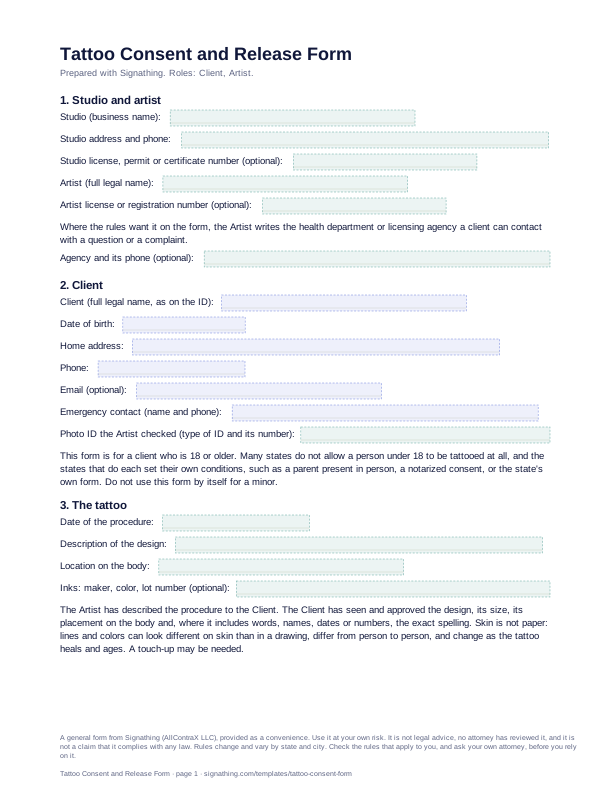
Tattoo Consent and Release Form
A consent, health questionnaire and release form for an adult tattoo client, built from what state health rules ask studios to collect: identification, health questions, the risks and permanence explained, the notice that inks are not FDA approved, care instructions, and both signatures. The page lists what every state and DC requires, with each rule cited.
Use this template needs a free Signathing account, which is a code to your email or mobile number, no password. It copies the document and all 50 fields into your templates so you can send it in a minute.
What is inside
- 1. Studio and artist
- 2. Client
- 3. The tattoo
- 4. Health questions
- 5. What the Client has been told
- 6. Care after the tattoo
- 7. The Client's statements
- 8. Release
- 9. Photos and studio policies
- 10. Records and local rules
- Signatures, with a signature, date and printed-name line for each role
Who signs
- 1. Client
- 2. Artist
Good for
- Every adult client, signed before the work starts
- A walk-in who fills it in on their own phone from a link at the counter
- Keeping the signed record on file for a health inspection
What each state says about tattoo paperwork
The form above is written once, for any state. Below is what each state's own rule says about tattooing a person under 18, what a studio must have the client sign or must record, and how long to keep it. Where a state has its own required form or wording, wants the form approved, or wants a paper record book, the note says so, and this form alone is not enough there.
Rules read on November 16, 2026. They change, and counties and cities often add their own. Follow the link and read the rule before you rely on a note here.
- AlabamaHas its own required form or wordingAlabama version with this wording
- Under 18: Only with the written informed consent of a parent or legal guardian, signed in the presence of the artist or an employee on the state's own Consent for Minor form, with a photocopy of the parent's photo ID kept.Paperwork: A signed client record (name, date of birth, address, date, operator, type and location of the procedure) and a medical history form covering at least the conditions on the state's model form, signed and dated by the client and the operator, with a copy to the client. A written site care sheet is required.Keep records: Permanently, with the last 3 years on the premises.Ala. Admin. Code r. 420-3-23-.07; Ala. Code § 22-17A-2
- AlaskaHas its own required form or wording
- Under 18: Not allowed for a minor, whatever a parent consents to.Paperwork: No consent form is named. The practitioner gives written educational information before the procedure and written aftercare instructions that the client and the practitioner sign and date, and the state board must approve the wording of both. A case history card is kept for each client.Keep records: 3 years after the client's most recent procedure.AS 08.13.215; AS 08.13.217
- ArizonaSet by counties and cities
- Under 18: Only with a parent or legal guardian physically present. The statute asks for no written form.Paperwork: We found no state rule on studio paperwork. Cities and counties may have their own; Sedona's city code is one example.Keep records: Not stated.A.R.S. § 13-3721; Sedona City Code ch. 8.45
- Arkansas
- Under 18: Not allowed under 16. At 16 or 17, written consent on a form the state health department has approved, with the parent or guardian present, photo ID from both and proof of guardianship.Paperwork: A record with the date, the client's name, address and date of birth, the design and location, the artist's name and license number, the client's signature and printed legal name, and a photocopy of the client's photo ID. The client signs a written notice that the tattoo should be considered permanent and attests to not being under the influence. The state approves the aftercare instructions.Keep records: 2 years from the last date recorded, by statute.Ark. Code § 17-26-602; 17 CAR § 54-306
- California
- Under 18: Not allowed, whatever a parent consents to.Paperwork: The client reads, completes and signs an informed consent form before the procedure. It must describe the procedure and what to expect afterward, state that body art is permanent, give notice that tattoo inks have not been approved by the federal Food and Drug Administration, and carry care instructions with the signs of infection. The client also completes and signs a health questionnaire on listed topics. County health agencies enforce the act and may add their own forms.Keep records: Not stated in the act; a county may set a period.Cal. Health & Safety Code § 119303; Cal. Health & Safety Code § 119302
- Colorado
- Under 18: Only with the express consent of a parent or guardian. The state does not say what form the consent takes; counties can add more.Paperwork: A consent form and client record with the client's name, address and phone, the date, the type and location of the body art, the studio and the artist, an explanation that body art should be considered permanent, possible side effects, when to consult a physician, how to care for the site, and proof that risks and aftercare were explained in writing and out loud.Keep records: 3 years, on the premises.6 CCR 1010-22, § 4-403; C.R.S. § 25-4-2103
- ConnecticutSet by counties and cities
- Under 18: Only with the permission of a parent or guardian. The statute does not say the permission must be written.Paperwork: We found no state rule on consent forms, client records or aftercare; the state licenses the technicians. Towns fill the gap with their own codes. West Haven's is one example.Keep records: Not stated by the state.Conn. Gen. Stat. § 19a-92g; Conn. Gen. Stat. ch. 387a
- Delaware
- Under 18: Only with the prior written, notarized consent of a parent or legal guardian to the specific tattoo.Paperwork: A signed release form confirming the health information was asked for, a health disclosure on listed conditions, and a record with the client's name, date of birth, address, a copy of the photo ID, the date, the technician, the type and location of the procedure and the client's signature. The state approves the educational information and aftercare instructions given to clients.Keep records: 3 years from the date of service.16 DE Admin. Code 4451; 11 Del. C. § 1114
- District of Columbia
- Under 18: The statute, amended in 2024, allows a tattoo at 16 or 17 with the written consent of a parent or legal guardian and none under 16. The 2017 regulations still say 18. Ask DC Health which it applies.Paperwork: The regulations we read name no customer consent form. They require a record of every procedure and written aftercare instructions with the artist's name and the establishment's name, address and phone.Keep records: 3 years, at the establishment.D.C. Code § 47-2853.76e; 25-G DCMR ch. 3
- Florida
- Under 18: Not allowed under 16. At 16 or 17, the parent or legal guardian comes along, both show photo ID, and the parent gives written notarized consent on the state's own form (DH 4146). This form does not replace that one.Paperwork: For an adult, a customer record: the artist's name, the customer's name, age and birth date, the tattoo and where it is, both signatures and the date. Aftercare is given out loud and in writing.Keep records: 2 years.Fla. Admin. Code r. 64E-28.009; Fla. Stat. § 381.00787
- GeorgiaHas its own required form or wording
- Under 18: Not allowed, with no parental consent exception.Paperwork: A signed application, a health history and a signed informed consent. The listed contents include a copy of the client's ID, a statement of not being under the influence, the county board of health's phone number, and both signatures with dates. The county board of health must approve the studio's form and its aftercare sheet before they are used.Keep records: 3 years, on the premises for the first year.Ga. Comp. R. & Regs. 511-3-8-.08; O.C.G.A. § 16-5-71
- HawaiiHas its own required form or wording
- Under 18: Only with the written consent of a parent or legal guardian, kept on file for 2 years.Paperwork: A customer record signed by the customer: date, name, address, age, the design and where it is on the body, and the artist's name. The rule says the record is written in ink in a bound book kept for that purpose, so an electronic form alone does not match the rule as written.Keep records: 2 years from the last entry in the book.Haw. Admin. Rules § 11-17-12; HRS § 321-379
- IdahoNo state rule found
- Under 18: Not allowed under 14. From 14 to 17, only with written informed consent signed by a parent or legal guardian in the presence of the artist or the artist's staff.Paperwork: We found no state rule on consent forms, client records or aftercare for adults. A city or health district may have its own.Keep records: Not stated.Idaho Code § 18-1523
- IllinoisHas its own required form or wording
- Under 18: Not allowed, with no parental consent exception.Paperwork: The studio must offer and explain the state health department's written public education materials, and the client and the studio both sign and date them. The rule also sets the wording of the health questions and requires government photo ID showing a birth date.Keep records: At least 1 year for the signed documents.77 Ill. Adm. Code 797.600; 720 ILCS 5/12C-35
- Indiana
- Under 18: Only with a parent or legal guardian present who gives written permission.Paperwork: The state rule requires a patron record (name, address, age, date, design, location on the body, artist) and names no signed consent. Counties license studios and can add more.Keep records: 2 years.410 IAC 1-5-28; Ind. Code § 35-45-21-4
- Iowa
- Under 18: Not allowed for a minor, defined as an unmarried person under 18. No parental consent exception.Paperwork: A client record with name, date of birth, a copy of the client's ID, the date, the artist's name and the client's signature. Printed aftercare instructions must be given.Keep records: 3 years, kept confidential.481 Iowa Admin. Code ch. 492; Iowa Code § 10A.531
- Kansas
- Under 18: Only with the written, notarized consent of a parent or court-appointed guardian, who must be present during the procedure.Paperwork: A client record (name, address, date and length of each service, type of ID shown, services provided) and written information before the service on possible reactions, side effects and complications. No signed consent is named for adults.Keep records: 5 years, including a minor's consent.K.A.R. 69-15-15; K.S.A. 65-1953
- Kentucky
- Under 18: Not allowed under 16. At 16 or 17, a custodial parent or legal guardian must consent in a written, notarized statement whose contents the regulation lists.Paperwork: A client record with the studio's name and certificate number, the date, the client's name, date of birth, address and phone, the artist, the type, location and description of the tattoo, and the client's attestation of not being intoxicated, not being pregnant and not having taken a blood thinner in the last 24 hours. Written information on infection risk, permanence and scarring from removal comes first.Keep records: 2 years.902 KAR 45:065; KRS 211.760
- Louisiana
- Under 18: Only with a parent, tutor or legal guardian who is present, consents and shows identification.Paperwork: A consent form signed before each procedure that covers the health risks and permanence and prominently states whether the inks are regulated or approved by the state or the federal Food and Drug Administration. The record includes each pigment's color, manufacturer and lot number.Keep records: 3 years.LAC 51:XXVIII.107; La. R.S. 14:93.2
- Maine
- Under 18: Not allowed, with no parental consent exception.Paperwork: The patron personally fills in and signs a record form: date, name, address, age, and the serial number of the picture ID. A medical history questionnaire, a signed copy of the written aftercare instructions and a receipt are also required. The rule refers to a record form provided for studios; we could not confirm whether the state issues one.Keep records: 2 years.10-144 C.M.R. ch. 210; 32 M.R.S. § 4203
- Maryland
- Under 18: The state rule sets no minimum age and requires the consent of a parent or guardian. Cities and counties can be stricter; Baltimore City does not allow tattoos under 18.Paperwork: Disclosure of the risks, the client's written consent, written aftercare, and a record of the customer's name, the date, the type of procedure and the technician. The rule also sets the wording of a notice the studio must post.Keep records: 3 years, for both the consent and the record.COMAR 10.06.01.06; Baltimore City Health Department, tattoo facilities
- MassachusettsSet by counties and cities
- Under 18: Set by each local board of health. The state's model regulation, Boston and Cambridge do not allow tattoos under 18.Paperwork: Nothing is statewide. The state's model regulation calls for a signed form: health conditions explained verbally and in writing, a statement that the client has no condition that prevents body art, consent, and receipt of aftercare. Boston and Cambridge require the local health agency to approve the studio's consent form.Keep records: 3 years under the model regulation and in Boston; each town sets its own.Mass. DPH model regulations for body art establishments; Boston Public Health Commission body art regulation
- MichiganHas its own required form or wording
- Under 18: Only with the written informed consent of a parent or legal guardian, signed in person at the studio, with the minor's birth certificate or proof of guardianship.Paperwork: The state has its own form, the Body Art Client Record and Consent (MDHHS-6326), with a disclosure statement and complaint notice. A studio's own form must be at least as complete as the state's and approved. The client gets a copy of the record.Keep records: 3 years, on the premises for the first year.MCL 333.13107; MDHHS body art forms and rules
- Minnesota
- Under 18: Not allowed, whatever a parent or guardian consents to.Paperwork: A health disclosure and authorization form with listed questions, signed and dated, and a signed and dated informed consent stating that a tattoo is considered permanent, may only be removed with a surgical procedure, and that any effective removal may leave scarring. Proof of age must come from a listed kind of ID. Aftercare is given verbally and in writing.Keep records: 3 years.Minn. Stat. § 146B.07
- MississippiHas its own required form or wordingMississippi version with this wording
- Under 18: Not allowed, with no parental consent exception.Paperwork: A consent form with 16 listed items, signed by the client and the tattooist, with a photocopy of the client's government ID attached. It must carry three statements whose content the regulation sets, including a recommendation in the name of the state Board of Health, which a general form does not carry.Keep records: 2 years, at the establishment.15 Miss. Code R. § 19-60-11.5.10; Miss. Code Ann. § 73-61-1
- Missouri
- Under 18: Only with the written informed consent of a parent or legal guardian, signed in the presence of the practitioner or the practitioner's staff.Paperwork: The patron's name, address, phone, date of birth and ID number; a health form on nine listed topics; a signed consent saying the patron was told in person and in writing of the dangers and that a tattoo should be considered permanent; and the practitioner's signed attestation. The record includes the lot number of each pigment.Keep records: 2 years after the procedure.20 CSR 2267-5; RSMo 324.520
- Montana
- Under 18: Only with a parent or legal guardian who signs the consent form in person and stays for the whole procedure.Paperwork: A consent form before each procedure: name and address, date, design, location on the body, a list of possible complications, the symptoms of infection, an instruction to consult a licensed medical provider, the permanent nature of the tattoo, and the client's statements of receiving aftercare in writing and verbally and of consenting. The health department says consent forms are subject to local and state approval.Keep records: 3 years, on the premises.ARM 37.112.144; Montana DPHHS sample consent form
- Nebraska
- Under 18: Only with the prior written consent of a parent or court-appointed guardian, who must be present during the procedure.Paperwork: A client record rather than a signed consent: name, address, date of birth, a copy of the client's photo ID, known allergies, any condition that may affect healing, the artist, the date, and the location and type of procedure. A signed consent form is named only for a client under 18.Keep records: 3 years for adults, 5 years for a client under 18.172 Neb. Admin. Code ch. 44, § 012; Neb. Rev. Stat. § 38-10,165
- Nevada
- Under 18: Only with the in-person consent of a custodial parent or legal guardian, who shows proof of custody or guardianship and signs the release form.Paperwork: A signed client release form with 12 listed items, including the operator's full legal name, the procedure and where it is on the body, an explanation that it should be considered permanent, the client's details and a copy of the client's photo ID. County health districts add more: Clark County also asks for a health questionnaire, ink lot numbers and its own aftercare statement.Keep records: 2 years, on the premises.NAC 444.00803; Southern Nevada Health District body art regulations (2022)
- New Hampshire
- Under 18: Not allowed, with no parental consent exception.Paperwork: The rules name no signed consent form for an adult. They require government ID and a copy of it (or the client's signed acknowledgment that ID was checked), disclosure of the health risks before starting, and aftercare in writing and out loud.Keep records: Not stated for adult records.N.H. Code Admin. R. Plc 600; RSA 314-A:8
- New Jersey
- Under 18: Only with the written consent of a parent or legal guardian, who comes along and shows identification. The studio photocopies both IDs.Paperwork: A client application (name, date of birth, proof of age, address, emergency contact, date, practitioner, type and location, signature), a health history form, and a consent form for each procedure that is gone over out loud and signed. Pigment lot numbers go in the record. Aftercare is given verbally and in writing.Keep records: 3 years.N.J.A.C. 8:27-4.2
- New Mexico
- Under 18: The rules do not rule it out. For a minor the record must hold written proof that a parent or legal guardian was present and consented. We could not confirm whether a statute sets an age.Paperwork: A signed form confirming that the health risks were explained verbally and in writing, that the client has no condition that prevents body art, that the client consents, and that aftercare instructions were given. The record includes the ink colors.Keep records: 3 years.16.36.5.11 NMAC
- New YorkSet by counties and cities
- Under 18: Not allowed anywhere in the state, and parental consent does not change that.Paperwork: The state has no operating rules in force for tattoo studios yet, so the county or city rule governs. New York City requires a signed written consent for each tattoo customer and written care instructions.Keep records: Not stated by the state. New York City: 2 years.N.Y. Penal Law § 260.21; NYS Department of Health, body art; NYC Health Code, 24 RCNY ch. 22
- North Carolina
- Under 18: Not allowed, with no parental consent exception.Paperwork: A signed patron record: name, address, phone number, date of birth and signature. The rules name no consent or release form and no aftercare sheet.Keep records: 2 years.15A NCAC 18A .3206; N.C. Gen. Stat. § 14-400
- North DakotaHas its own required form or wordingNorth Dakota version with this wording
- Under 18: Only in the presence of, and with the written consent of, a parent or legal guardian.Paperwork: A new Body Art Code took effect October 1, 2026. It requires an informed consent and release form with a risk section, a client evaluation whose opening sentence and ten questions the rule words, and an aftercare section the health department must approve, plus a copy of the client's ID and ink lot numbers.Keep records: 3 years.N.D. Admin. Code ch. 33-41-01.1; N.D.C.C. § 12.1-31-13
- Ohio
- Under 18: Only if a parent, guardian or custodian comes to the studio in person at the time and signs a document from the studio that explains the procedure, the body part and the care afterward.Paperwork: No signed consent is named for an adult. The studio keeps a record of each patron (name, address, date, the colors and maker of the inks, placement) and gives aftercare verbally and in writing. Local boards of health may add conditions.Keep records: 2 years.Ohio Adm. Code 3701-9-04; Ohio Rev. Code § 3730.06
- Oklahoma
- Under 18: Not allowed, with no parental consent exception.Paperwork: A signed consent form with listed contents: the studio, the client's name, date of birth and address, the date, the procedure and its location, health questions, the artist's name, license number and signature, and a photocopy of the client's photo ID. Aftercare is given verbally and in writing before the procedure starts.Keep records: 3 years.OAC 310:233-3-6.1; 21 O.S. § 842.1
- Oregon
- Under 18: Not allowed whatever a parent consents to, unless a physician's statement authorizes it.Paperwork: A client record with contact details, medical and skin notes, sensitivities and any bleeding disorder, plus a copy of the client's photo ID. The client is told verbally and in writing about the procedure, its risks and aftercare, and signs for it. The state publishes a form studios may use; it is optional.Keep records: 3 years, at the facility for the first 90 days.OAR 331-915-0085; OAR 331-915-0065
- PennsylvaniaSet by counties and cities
- Under 18: State law requires a parent or guardian to consent and be present. Philadelphia is stricter: none under 16, and written in-person consent with ID at 16 and 17.Paperwork: We found no state rule on studio paperwork, so a city or county rule governs where there is one. Philadelphia requires a record of each tattoo and care instructions given verbally and in writing before the procedure.Keep records: Not stated by the state. Philadelphia: 2 years.18 Pa.C.S. § 6311; Philadelphia body art regulations
- Rhode IslandHas its own required form or wording
- Under 18: Not allowed, except a tattoo for medical purposes with notarized consent from a parent and a physician.Paperwork: No signed consent is named for an adult. The parlor keeps a patron record (date, name, address, phone, age, a copy of the photo ID, the design and its location, the artist) entered in a book with pre-numbered pages kept for that purpose, so an electronic form alone does not match the rule as written.Keep records: 5 years.216-RICR-40-10-15; R.I. Gen. Laws § 11-9-15
- South Carolina
- Under 18: Not allowed, with no parental consent exception. The artist checks picture ID.Paperwork: A signed informed consent or release form in which the client chooses in writing to be tattooed. It must carry information on the risks, a notice about how a tattoo can affect giving blood, aftercare for the specific site, and a signed statement of not being impaired by drugs or alcohol. Tattooing the head, face or neck is not allowed.Keep records: 6 years.S.C. Code Regs. 60-111; S.C. Code Title 44, ch. 34
- South Dakota
- Under 18: Only with a consent form signed by the parents or legal guardian. No minimum age is stated.Paperwork: Signed consent from the patron before the service, and a record of name, address, age, the consent form, and where the tattoos are and what they are. Written care instructions are required. Cities license studios and can add more.Keep records: At least 2 years.ARSD 44:12:01:13; SDCL 26-10-19
- Tennessee
- Under 18: Not allowed, except to cover up an existing tattoo at 16 or 17 with written consent from a parent or legal guardian who is present.Paperwork: A signed client record: date, printed name, signature, address, age or date of birth, the design, its location, and the artist. The client also attests to not being under the influence of drugs or alcohol. Written aftercare instructions are required.Keep records: 2 years.Tenn. Comp. R. & Regs. 1200-23-03; T.C.A. § 62-38-207
- Texas
- Under 18: Not allowed, except to cover an existing tattoo with a parent or guardian who is present and signs an affidavit.Paperwork: A client record with eight listed items, including the type of photo ID shown, the colors used, the location on the body, the artist, a statement that the client received and read written care instructions, and the client's signature. Risks are disclosed verbally and in writing first. The state health department publishes a sample record form.Keep records: 2 years from the last entry.25 Tex. Admin. Code § 229.406; Tex. Health & Safety Code § 146.012
- UtahHas its own required form or wordingUtah version with this wording
- Under 18: Only with a parent or legal guardian present who proves identity and relationship and signs written permission.Paperwork: A client consent and disclosure form, on paper or digital, whose contents a statewide rule fixes: listed risk statements, one sentence that must appear word for word, and eleven screening questions. A general form does not carry that exact sentence or all eleven questions. The rule was renumbered on August 3, 2026; the consent section is now R392-701-16.Keep records: 3 years after the procedure.Utah Admin. Code R392-701-16; Utah Code § 76-9-2002
- Vermont
- Under 18: Only with written consent that a parent or guardian signs in front of the tattooist, certifying under penalty of perjury that it is true.Paperwork: A signed and dated consent form that explains the procedure, says tattooing is permanent and that removal may not be complete and may leave scarring, lists possible complications, and asks listed questions about alcohol or drugs, food and medical conditions. A separate signed acknowledgment of the tattooist's written disclosure is also required.Keep records: At least 2 years.Vt. OPR rules for tattooing and body piercing; 26 V.S.A. § 4102
- VirginiaHas its own required form or wording
- Under 18: Only in the presence of a parent or guardian, who also signs the state's disclosure form.Paperwork: The state board's own Tattoo Client Disclosure Form (A450-12TDIS) must be signed by the client and the tattooer. The studio's own record adds the client's details, a copy of the photo ID, the colors used with the maker's catalogue numbers, the location on the body and the artist.Keep records: 2 years from the last entry.18VAC41-50-410; DPOR Tattoo Client Disclosure Form
- Washington
- Under 18: Not allowed, with no parental consent exception.Paperwork: A signed client record: name, age, address, date, the practitioner's name, and the location and type of procedure. The state rules name no consent form and no aftercare sheet.Keep records: At least 2 years.WAC 308-22-070; RCW 26.28.085
- West VirginiaHas its own required form or wordingWest Virginia version with this wording
- Under 18: Only with prior written consent from one parent or guardian, kept on file 5 years.Paperwork: A signed patron record (name, address, age, date, design, location, artist) and the patron's attestation of not being intoxicated. The studio must hand out the state health department's own written sheet on possible complications and get a written acknowledgment that the patron received it. The statute says record entries are made in ink or indelible pencil.Keep records: 5 years.W. Va. Code § 16-38-3; WV Department of Health, Risk Factors Associated with Tattoos (DC-11)
- WisconsinHas its own required form or wording
- Under 18: Not allowed, except by a physician in the course of practice.Paperwork: Signed informed consent on a form the state licensing department has approved; it publishes its own, Form 3204. The record adds the patron's name, address and age, the practitioner, and any adverse effects. Care instructions are given out loud and in writing afterward.Keep records: 2 years after the procedure.Wis. Admin. Code SPS 221.10; Wis. Stat. § 948.70
- WyomingSet by counties and cities
- Under 18: Only with the consent of a parent or legal guardian who is present, and the artist must ask for proof of age. Counties can add more: Casper-Natrona County requires notarized consent.Paperwork: We found no state rule on studio paperwork; county health departments set their own. Casper-Natrona County requires a detailed consent and release form with set risk statements and screening questions.Keep records: Not stated by the state. Casper-Natrona County: 3 years.Wyo. Stat. § 14-3-107; Casper-Natrona County body art regulations (2025)
Questions
- Is the Tattoo Consent and Release Form free to use?
- Yes. Download the blank PDF, or copy it into a free Signathing account and send it for signature as many times as you like. There is no card and no trial.
- Who signs the Tattoo Consent and Release Form?
- 2 roles: Client and Artist. Each role has its own signature, date and printed-name fields at the end, and the fields in the body are assigned to the role that fills them in.
- Can I change the wording?
- Yes. Download the PDF and edit it in any PDF editor, or write your own version and upload it as a template. The fields are yours to move, add or delete in the template editor after you copy it.
- Does it work in my state?
- It is one form for any state, written from what the states' own rules ask a business to collect. We read the rule in every state and DC and list what each one says, with the citation, further down this page. 13 of them have their own required form or wording, or another step a general form cannot do; there the note says so and this form by itself is not enough. Counties and cities can add their own rules.
- Is this legal advice, and was it reviewed by a lawyer?
- No to both. You use it at your own risk. We research each template and cite the rules we relied on, but no attorney has reviewed it. It is a general form, not legal advice, and we do not promise it meets the law where you are. Laws differ by state and city, and they change. Have your own attorney read it before you rely on it.
More templates
- Auto Repair Estimate and Authorization
A written estimate and signed repair authorization for a repair shop and its customer: the vehicle, the work asked for, an itemized estimate with a total, the charges to know about first, what happens to replaced parts, and a promise that nothing is done or charged beyond the estimate until the customer says yes. The page lists what every state and DC requires, with each rule cited.
- Authorization for Additional Auto Repairs
A one-page approval for work or cost beyond the original estimate: what the shop found, the added repairs and price, the new total, and the customer's choice to approve it, decline it and finish what was already approved, or stop. It gives the shop a signed record, with the date and time, of the consent most state rules ask it to get before going over an estimate.
- Tanning Customer Acknowledgment
A warning statement and acknowledgment for an adult customer of a tanning facility, built from what state rules ask a customer to read and sign: the risks of ultraviolet light, medications and products that raise sensitivity, skin type, protective eyewear, and time between sessions. The page lists what every state and DC requires, with each rule cited.
All free templates
- Residential Lease Agreement
- Rental Application
- Move-In / Move-Out Inspection Checklist
- Liability Waiver and Release
- Independent Contractor Agreement
- Construction Change Order
- Month-to-Month Lease
- Sublease Agreement
- Gym and Fitness Waiver
- Event Participation Waiver
- Equipment Storage Waiver
- Signature Acknowledgment
- Conditional Lien Waiver
- Unconditional Lien Waiver
- Non-Disclosure Agreement
- Photo and Video Release
- Roommate Agreement
- Scope of Work Agreement
- Subcontractor Agreement
- Small Job Agreement
- Promissory Note
- Bill of Sale (As-Is)
- Personal Guarantee
- Business Credit Application
- Recurring Payment Authorization
- Policy Acknowledgment
- Change of Terms Acknowledgment
- Service Intake and Consent
- Rent Receipt
Free, and not the kind of free with a catch
Unlimited documents, up to 25 signers each, certified PDFs on every one. No trial clock and no card to start.
Start signing free